Do you really know Alpe d’Huez? Behind this world-famous resort lies an extraordinary story that will give you goosebumps. From medieval miners to Olympic champions, this mountain has lived a thousand lives before becoming the “Island of the Sun” that we love today.
Brandes: The Medieval Secret of Alpe d’Huez
A Village Perched in the Clouds
Just imagine: in the 12th century, at an altitude of more than 1,800 meters, a group of brave men settled on a windswept plateau to mine a deposit of silver-bearing lead. That’s the incredible story of the village of Brandes!
Why up there? Because this mountain hid a treasure: silver! The medieval archaeological site of Brandes, designated a historic monument, is a silver-mining village that was inhabited from the 12th to the 14th century.
The Daily Life of Medieval Miners
The medieval village consisted of a castle, a parish church with a cemetery, about 80 homes, open-pit and underground mines, and several industrial districts. What an impressive layout!
How did they work? Mining was done using fire because the heat from the flames softened the rock and caused it to flake off; all that was needed then was to knock it loose with a pickaxe. In the dark tunnels, these men used their lamps for light and sometimes walked on floors suspended in mid-air. Thrills guaranteed!
The End of an Era
The mine closed in the 1330s due to flooding. The village was then quickly abandoned by its residents. After more than 150 years of intense activity, Brandes faded into obscurity…
Today? You can visit this exceptional archaeological site! It’s the highest known medieval village in Europe, associated with a silver mine. A visit here will literally transport you back to the Middle Ages.
From Rural Tranquility to a Skiing Adventure
Modest Beginnings (1900–1930)
For centuries after Brandes, L’Alpe was originally a hamlet of about thirty chalets that served as a summer residence—from June through September—for farming and livestock raising. Life went on peacefully, following the rhythm of the seasons…
Then came skiing! The advent of skiing in the early 1900s marked a turning point in the history of Alpe d’Huez. The first skiers discovered this sun-drenched plateau and fell in love with it.
1923: The Tourism Boom
Recognizing the Alpe d’Huez’s potential as a tourist destination as early as 1923, the Touring-Club de France converted an alpine chalet into a dormitory-style lodge to accommodate tourists. These were the first steps toward what would become a revolution!
Our take: What a vision for the future! These pioneers recognized the potential of this exceptional site long before anyone else did.
1936: The Birth of a Legend
The First Hotels
In 1934, the first hotels were built: Les Trois Dauphins, Le Refuge, the Bel Alpe, and l’Éclose. The hotel infrastructure expanded rapidly to accommodate this new clientele of skiers.
The World’s First Ski Lift!
Here is the historic moment: In 1936, Jean Pomagalski built the world’s first detachable chairlift. It became the “Éclose” ski lift on the “Piste des Idiots,” featuring wooden poles and pylons, with a vertical rise of 50 meters.
Can you believe it? The Alpe d’Huez was the birthplace of the very first modern ski lift! From this sun-drenched plateau, Jean Pomagalski revolutionized the world of skiing forever.
A Station Taking Off
On the eve of the war in 1939, Alpe d’Huez was already a thriving resort with 16 hotels, 3 ski lifts reaching an altitude of 2,000 meters, and a ski school affiliated with the Ski-Club de Paris.
The Boom of the 1950s and 1960s
The Postwar Boom
After the war ended in 1945, development in Alpe d’Huez picked up again in full force, at a breakneck pace. The French rediscovered the joy of vacationing, and Alpe d’Huez reaped the benefits!
The numbers speak for themselves: 70% of the clientele at that time was from Paris. Paris is discovering its favorite mountain!
1952: Fausto Coppi Makes History
In 1952, Fausto Coppi won the Lausanne–Alpe d’Huez stage of the Tour de France. It was the first mountain finish in the history of the Tour de France at Alpe d’Huez!
The standout detail: The Italian completed the climb at an exceptional speed for the time—18.654 km/h. This victory launched the cycling legend of Alpe d’Huez!
1958: The Founding of SATA
In 1958, the SATA (Société d’Aménagement Touristique de l’Alpe d’Huez) was founded: it manages the ski lifts and builds new ones.
Why is it great? Alpe d’Huez has thus created a unique and ingenious organizational model: the resort operators and the municipality collectively own the ski lift network. This innovation prevents conflicts and optimizes development!
The Glorious Years (1960–1980)
The Revolutionary Cable Car
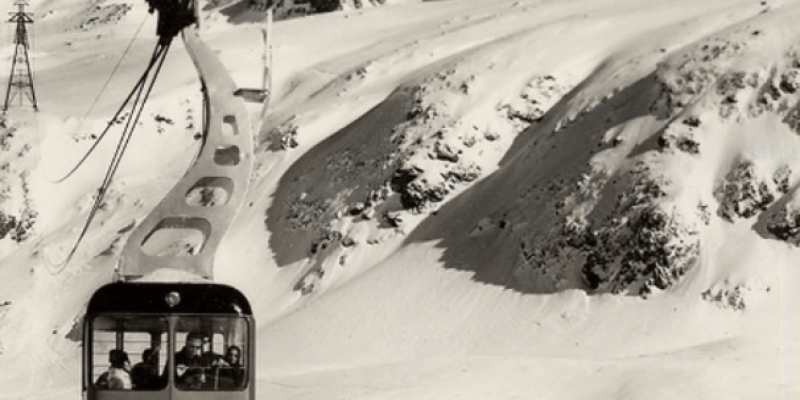
In 1962, the third section of the cable car (3,330 m) began operating. Access to the Pic Blanc completely transformed the skiing experience! Imagine how the first skiers must have felt when they discovered this breathtaking panorama.
1964: The Tunnel, a Technical Feat
In 1964, “Le Tunnel” was created—a 200-meter-long corridor located at an altitude of 3,000 meters. It connects the Sarenne Glacier to the southern slope of the mountain range. This legendary run still challenges even the most seasoned skiers today!
1968: The Olympic Games!
A moment of immense pride: In 1968, the resort hosted the bobsled event at the Olympic Games and served as the alternate venue for the alpine skiing competitions. Alpe d’Huez joined the ranks of the world’s leading international resorts!
Bonus fact: The bobsled track cost 6.7 million francs, and 40-year-old Italian pilot Eugenio Monti won the gold medal in both events.
The Tour de France: A Love Story
The 21 Legendary Turns
The climb up Alpe d’Huez consists of 21 turns, numbered in descending order by road signs. According to legend, the turns on Alpe d’Huez were numbered to serve as landmarks for snowplows.
Impressive stats: Elevation gain: 1,121 m, Distance: 14.454 km, Average gradient: 7.9%, Maximum gradient: 14%. On average, nearly 300 cyclists tackle this legendary climb every day!
Legendary Records
Since 1995, Marco Pantani has held the record for the climb at 36 min 40 s. A time that seems unbeatable! Pantani’s other performances are just as impressive: 36 minutes and 45 seconds in 1997 and 37 minutes and 15 seconds in 1994.
Names Etched in History
The rider who wins the stage has his name engraved and associated with one of the 21 hairpin turns on the legendary climb. Every turn tells a story; every sign commemorates a feat!
The Dutch Turn: Starting in the 1970s, Dutch victories became more frequent, and Dutch fans would gather at Turn No. 7 every time the race passed through it. The atmosphere there is legendary!
Discover all the Tour de France winners at Alpe d’Huez on the resort’s official website.
The Modern Era (1980–Present)
Neighborhood Development
Between 1980 and 1989, Alpe d’Huez built the Éclose neighborhood. Between 1985 and 1990, the Bergers neighborhood was built. The resort took shape and was modernized.
1986: The 50th Anniversary in Style
The year 1986 marked the resort’s 50th anniversary, which was highlighted by the inauguration of AGORALP, the installation of the Grandes Rousses DMC (Double Monocable), and the opening of the Marmottes gondola.
1997: The Comedy Festival
1997: The first edition of the Alpe d’Huez International Comedy and Humor Film Festival. This cultural innovation adds an artistic dimension to the resort! Check out the festival program to find out about upcoming editions.
Alpe d’Huez Today: A Living Legacy
The Numbers That Inspire Dreams
Part of one of France’s largest ski areas (Alpe d’Huez Grand Domaine Ski), Alpe d’Huez offers 250 kilometers of slopes and 67 ski lifts. It enjoys 300 days of sunshine a year!
Preserved Traditions
The traditions of the Oisans region are reflected in its cuisine and rural way of life, epitomized by the transhumance of some 370 cows and 2,000 sheep that graze on 10,000 hectares of pastureland, which becomes ski slopes in the winter.
What we love: This ultra-modern resort has never forgotten its roots! The name itself comes from the “alpe” of the village of Huez—the mountain pastures where herds still graze.
Explore the History of Alpe d’Huez Today
The Brandes Site
Don’t miss a tour of the Brandes archaeological site! Guided tours are organized by the Cultural Department of the town of Huez. It’s a fascinating journey back in time.
The Huez and Oisans Museum
In 1982, the Maison de l’Alpe was established; it would house the Tourist Office, the ESF, and the ski lift ticket offices. That same year, the Museum of Huez and Oisans opened.
Where can you find it? AtAGORALP, you’ll discover all of Brandes’ archaeological treasures.
Must-See Landmarks
The Notre-Dame des Neiges Church is worth a visit: this modern and unique church was designed by architect Jean Marol in the 1960s and features colorful stained-glass windows by the artist Arcabas.
The Events That Shape History
The Marmot
Every July, the resort serves as the finish line for the La Marmotte cyclosportive, which attracts between 6,000 and 7,000 participants. A tradition that keeps the love of cycling alive! Discover La Marmotte to enjoy this unique experience.
Alpe d’HuZes
Since 2006, the Alpe d’HuZes charity event has been organized by Dutch people fighting cancer. Participants must bike up Alpe d’Huez six times. An extraordinary challenge for a noble cause!
Our Enthusiasts’ Perspective on This Story
What Moves Us
This story resonates with us because it shows how ordinary people have created something extraordinary. From the medieval miners of Brandes to the pioneers of skiing, and from Jean Pomagalski to the Tour de France champions, every era has contributed its part.
Lessons from the Past
Constant Innovation: From the first ski lift to the new gondolas of the Altitude 3300 Project, Alpe d’Huez has never stopped innovating.
Respect for traditions: Despite modernization, the resort has managed to preserve its character and rural roots.
Openness to the World: From the Tour de France to the Olympic Games, Alpe d’Huez has always had an international outlook.
Alpe d’Huez: A Story That Continues
Today’s Challenges
Today, Alpe d’Huez faces the challenges of modern tourism: sustainable development, climate change, and new expectations from visitors. But this resort has already overcome so many trials!
Our Vision for the Future
With its rich history and legendary ability to adapt, Alpe d’Huez has everything it takes to write new and exciting chapters. The Altitude 3300 Project is proof of that!
Conclusion: One Mountain, a Thousand Stories
From Brandes to the present day, Alpe d’Huez tells the story of the French mountains. Every rock, every lift, every turn speaks to us of the men and women who transformed an alpine pasture into a world-class destination.
Our top tip: When you visit Alpe d’Huez, take the time to visit Brandes, ride down through the village of Huez, and climb the 21 hairpin turns by bike. You’ll never see this resort the same way again!
This mountain has a soul, and its history is part of its irresistible charm. So, are you ready to discover—or rediscover—Alpe d’Huez in a whole new light?
Related articles:
Useful links: