1,053 Snow Guns to Save the Season: The Resort’s Nerve Center
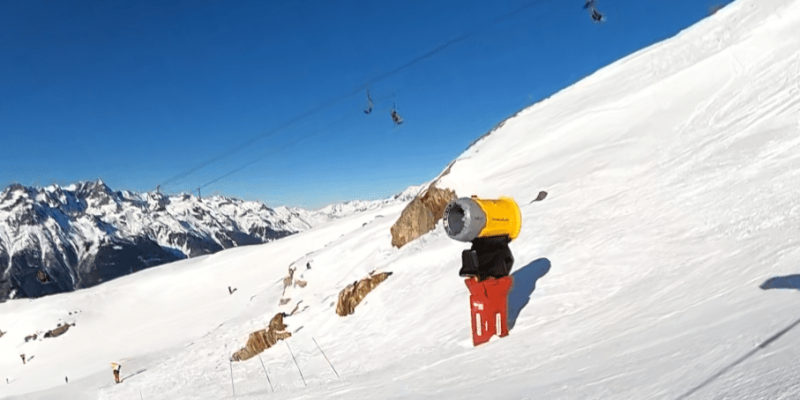
At Alpe d’Huez, 1,053 snowmakers cover 88 kilometers of slopes—35% of the ski area—from the Pic Blanc at 3,060 meters down to the lower connecting runs at 1,035 meters ( Skiresort). This sprawling network is no luxury: even the legendary Sarenne run, at an altitude of 3,330 meters, has had to install snowmakers in recent years, because “more than 6,500 skiers descend the run on some days during the Christmas holidays.” Snow cannons on the Sarenne run – Lyon Capitale. Because contrary to what one might think, altitude alone is no longer enough: technology is needed to compensate for unpredictable weather conditions.
The Magic of “Wet-Bulb Temperature”: When -2°C Is Enough
The secret behind snowmaking lies in a little-known weather parameter: wet-bulb temperature, which is the temperature recorded by a thermometer whose bulb is covered with a wick soaked in water. Just as with natural snowfall, artificial snowmaking requires the right combination of air temperature AND humidity. Frequently asked questions about TechnoAlpin and artificial snow. Control systems have the psychrometric chart stored in their memory and calculate the wet-bulb temperature at all times, then decide whether or not to activate the snowmaker based on the desired snow quality. Result: snow can be produced at a wet-bulb temperature of -2°C instead of having to wait for -10°C! Real-time temperature and humidity sensors, along with anemometers, automatically control the entire system.
From Water to Powder in 5 Steps: The Nucleation Process
Snow production involves five fascinating technical steps. First, atomization breaks the water jet into fine droplets small enough to crystallize into ice as soon as they are sprayed into the ambient air at subzero temperatures. Next comes nucleation: the droplets are transformed into frozen grains when the equilibrium of supercooled water is disrupted at temperatures as low as -3°C (relative humidity), thanks to contact with the nucleation flow. The snowmakers’ nucleators produce a mixture of water and compressed air that forms nuclei when it comes into contact with the ambient air, while the nozzles spray the water into very fine droplets that bind to the nuclei. Frequently asked questions about TechnoAlpin and artificial snow. The dispersion system then propels these droplets into the air, where they quickly turn to ice, while the evaporation of their outer layer facilitates the freezing process. It’s magic!
1,000 m³ of Water = 2,500 m³ of Snow: Numbers That Make Your Head Spin
One cubic meter of water produces an average of 2.5 cubic meters of snow, and nearly 1,000 cubic meters of water are needed to create the base layer of snow on a one-hectare slope Frequently Asked Questions About TechnoAlpin and Artificial Snow —that’s less than one-third of an Olympic-sized swimming pool. The TR10, the most powerful fan-type snow gun on the market, produces about 10 truckloads of snow per hour under ideal conditions! In terms of power consumption, technology has made great strides: TechnoAlpin’s new snow guns produce 30% more snow than they did 15 years ago using the same amount of energy, and automatic systems require 30% less energy than manual ones. Water temperature is crucial: the colder it is, the faster crystallization occurs, and it is virtually impossible to operate a snowmaking machine with water warmer than 4°C. Snow cannon — Wikipedia.
The Silent War Against Global Warming: Innovation vs. Nature
This equipment was installed due to the lack of natural snowfall in recent years, as well as the growing number of visitors to the slopes. Snow cannons on the Sarenne slope – Lyon Capitale. There is no actual water consumption involved in snowmaking; rather, it is simply a matter of water withdrawal: as the snow melts and evaporates, 100% of the water eventually returns to the natural environment. This technological innovation allows Alpe d’Huez to maintain its reputation for reliability: the ski area boasts a guaranteed 5-star snow cover rating out of 5, and the run down to the valley is almost always open. Snow reliability at Alpe d’Huez—snow guaranteed at Alpe d’Huez. Snow cannons don’t create water: they transform it into crystals at the right time, where it’s needed, when Mother Nature falls short. A technical feat that saves our winters!