1881: When Only Mules Climbed to the Alpine Pastures
Until 1881, the climb up Alpe d’Huez was accessible only to men and mules. Only 2 to 3 meters wide, with steep slopes and sudden changesin direction ,this route was anything but pleasant or tourist-friendly. Imagine the d’Huizats—the mountain folk of Huez—struggling uphill with their animals laden with hay and provisions on their way to their summer pastures! Joseph Collomb, a local from Huez, ran a small transport service for people and goods between the valley and the village of Huez: back then, it took just 2 hours and 30 minutes to make the trip by horse-drawn carriage. The Ascent of Alpe d’Huez – Must-Sees – Oisans, the Legendary Alps. This dirt and gravel road was the only link between the Oisans Valley and the Alpe plateau, where shepherds had been making the ascent every summer for centuries.
1926: Léon Perrier, the Man Who Opened Up the Mountain
The revolution came in 1926 thanks to a providential figure: Mr. Léon Perrier, president of the General Council, who made the connection a reality with a 4-meter-wide road. The Ascent of Alpe d’Huez – Must-Sees – Oisans, the Legendary Alps. This drivable road changed everything! It was a true economic revolution for Huez: transporting hay from the mountain pastures and coal mined from the Herpie mine, located at an altitude of 2,300 meters, became much easier. The climb up Alpe d’Huez – Must-See Attractions – Oisans, the Legendary Alps. The first intrepid motorists began to discover this sun-drenched plateau. But the road remained narrow, winding, and, in winter, completely impassable.
1936: The Introduction of Numbered Turns for Snowplows
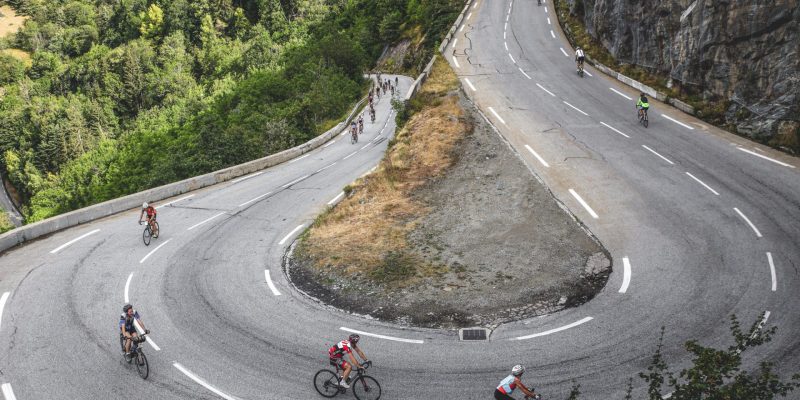
By 1936, the expansion work was nearly complete, with the construction of two parking lots: one measuring 3,000 square meters that could hold nearly 200 cars at Alpe d’Huez, and the other measuring 2,000 square meters in the village of Huez. Widening and snow removal on the Huez Road in 1936 | Association. But here’s the little-known detail that would make it legendary: these markers counted the turns to serve as reference points for snowplows as they made their way up to the resort.Oz-en-Oisans Tourist OfficeWikipedia! Engineers needed reliable reference points for these machines that cleared snow from the road in the darkness of winter. A building was even constructed at Alpe d’Huez to house two snowplows as well as the personnel needed to operate them . Widening and Snow Removal on the Alpe d’Huez Road in 1936 | Association. These utilitarian signs would go on to become the most famous in the world of cycling.
1952: Fausto Coppi Turns a utilitarian road bike into a legend
In 1952, when the mayor told shopkeepers and hoteliers that if they wanted the Tour de France to come to their town, they would have to pay out of pocket, as the town hall couldn’t afford it, who could have foreseen this future success? The climb of Alpe d’Huez – Must-sees – Oisans, the mythical Alps. Yet, Alpe d’Huez inaugurated the very first summit finish in the history of the Tour de France with a victory for Fausto Coppi, who climbed the ascent in 45 minutes and 22 seconds (Wikipedia Oisans ). After a duel against the Frenchman Jean Robic, Coppi arrived with a 1’20” lead . The climb of Alpe d’Huez – Must-sees – Oisans, the mythical Alps . The old snowplow tracks suddenly became the milestones of a global sporting epic!
Today: 300 Cyclists a Day on the Trails of History
Today, on average, nearly 300 cyclists tackle the legendary climb each day, more than 7,000 touring cyclists participate in the Marmotte Granfondo, and 2,000 receive a certificate officially recognizing their Alpe d’Huez Oisans ascent time. In 1999, for the 21st visit of the Tour de France, the names of the 21 winners of this already iconic stage were added to the numbers of the 21 hairpin bends . These signs, originally created out of technical necessity for snowplows in the 1930s, now bear the names of Coppi, Hinault, Pantani, and Pinot. Each bend tells a story, each hairpin evokes a feat. The road once used by mules and shepherds has become the Mecca of cycling, the race to be completed at least once in a lifetime : Alpe d’Huez Oisans . A utilitarian mountain road transformed by history into a monument of world sport.